00:08 I grew up in the 70s.
00:10 Back then, there was the Soviet Union,
00:12 with its risk of nuclear war.
00:14 There were very deadly wars in Lebanon,
00:19 in Algeria previously, in Latin America.
00:22 So it doesn't seem to me that the current situation of the world
00:24 is any more disturbing than it was in the past.
00:28 Yes it is true, the world is changing.
00:30 First of all, we have the digital transition
00:33 which is going to change it in many ways.
00:37 Then there's ecology, of course,
00:39 and the ecological transition.
00:41 And the third transformation, or transition,
00:44 is the geopolitical evolution
00:46 with the redefinition of East and West.
00:54 Digital is indispensable in our lives.
00:58 It saves us time, increases productivity,
01:01 it facilitates international dialogue.
01:04 So, for me, the digital world, the internet
01:06 And social media is very positive.
01:08 And like all positive developments, there is also damage.
01:14 These are very complex, interlinked fields,
01:17 so we can't pretend not to see fake news,
01:20 if we look at Google, Facebook and Twitter.
01:23 Fake news is very difficult to control.
01:25 It's about who says it, how they say it, why they say it.
01:29 I would say there are fake news that are...
01:32 At the end of the day, we have the right to...
01:34 We have the right to think badly.
01:36 We have the right to say false or stupid things.
01:38 But this is annoying or a real problem,
01:41 if the incorrectness leads to serious consequences.
01:45 For example, inaccuracies or lies about vaccines,
01:50 about terrorism, about Islam...
01:52 Even if they can be criticised.
01:54 I don't think it can be deduced from the 'fake news'.
01:56 that we live in a bad world.
01:58 It might sound a bit presumptuous,
02:02 but what I read on the internet gives me a lot of information.
02:06 There are a lot of great articles.
02:08 I like to talk to my friends on social media.
02:12 I post a lot of texts that I find valuable on Twitter.
02:15 and maybe that's all very positive.
02:34 The main idea of Mainstream is that we are geolocated,
02:38 that there is indeed global content,
02:40 most of it American, which is going to be broadcast all over the world.
02:43 But there are also, however, everywhere,
02:46 powerful local cultures, music in Mexico,
02:49 K-pop in Korea, J-pop in Japan,
02:53 TV series in Asia,
02:56 Ramadan soap operas in the Arab world.
02:58 To tell the truth, borders have never disappeared.
03:03 For example, in France we don't know Televisa,
03:06 Telemundo or TV Globo or Telefe, which are very important channels.
03:10 that speak to millions, tens or hundreds of millions of people.
03:14 They have no impact in France.
03:16 In other words, we don't live in a flat world.
03:20 We don't live in a world...
03:22 There are still borders, even if they are not geographical
03:26 and they depend on the territory in which we live,
03:30 the language we speak, the culture we live in.
03:34 The example of the Basque Country is very interesting.
03:36 There is the Basque identity.
03:38 There is the identity of the Spanish Basque Country.
03:41 There can be a Spanish identity
03:42 that makes you feel akin to the Catalans or the Madrilenians
03:46 on certain issues,
03:47 and maybe even contrary to the French.
03:49 On that subject, you may be Spanish, but..,
03:52 at the same time, the French and the Spanish,
03:55 like the Europeans that we are,
03:57 we will stand united against China or the United States.
04:00 That's why I believe in multiple identities.
04:03 And I believe that, thanks to the internet,
04:05 these multiple identities spread more easily than before.
04:09 From this point of view, it's a positive thing.
04:15 I think that the cultural life, and therefore,
04:17 economic life are built in concentric circles.
04:21 There is a first circle, the smallest circle,
04:23 in which is contained the Art with capital letters,
04:27 i.e. classical production, often without profit,
04:31 of visual art, literature, photography,
04:36 dance, theatre, etc.
04:39 Then there are the cultural industries.
04:41 It's the second concentric circle,
04:43 wider than that of the arts,
04:46 and it contains the book industry, the music industry,
04:50 the video game industry, the digital industry.
04:53 All that is culture.
04:55 In a third circle we have the so-called related activities.
05:00 For example, if we think about a theatre festival,
05:02 would be the box office people, the press officers,
05:07 the people who print the posters, the people who build the stage,
05:11 the electricians, the video makers.
05:14 All these are the activities related to the cultural sector.
05:18 Finally, there's a fourth sphere of unrelated activities,
05:23 that is, those that are linked in a certain way
05:26 for their contribution to culture.
05:29 For example, hotels, means of transport,
05:32 restaurants, bars,
05:34 the train that takes you to the city, the plane, etc.
05:38 So, it's clear that the culture,
05:40 even if it seems to be strictly limited to art,
05:46 it can nurture an ecosystem, like here in San Sebastian,
05:51 which is richer than we think.
05:53 That's why culture is not just an expense,
05:57 as cities or politicians often tend to think,
06:00 but an investment, because by investing in culture,
06:03 we nurture an ecosystem that is going to benefit
06:06 the city or the region as a whole.
06:16 Places need time to exist.
06:19 Think of the Guggenheim Museum in Bilbao.
06:23 It was created 25 years ago.
06:24 The impact is often visible in the medium to long term.
06:28 So we have to consider it as a mixture of culture,
06:37 of cultural industry and digital,
06:40 but also a social mission
06:42 with regard to the city and even the neighbourhood,
06:44 as in this case.
06:46 In addition, there is also work on the Basque language.
06:51 What should concern us is the fact that
06:55 that not all these dimensions have been reached at this stage.
06:59 Tenants or components can be added to the assembly,
07:05 circulation can be modified,
07:08 tables and chairs can be placed.
07:10 We realise that the migrants
07:12 come just for the electricity,
07:14 to download and charge their mobile phones.
07:17 Well, that's interesting.
07:18 We can share a slightly racist position
07:21 and of bad locals saying that we don't want to
07:25 migrants to come.
07:27 We don't want them to come into this building.
07:29 My position is just the opposite.
07:31 If the migrants didn't come
07:33 and consider that this building doesn't belong to them,
07:36 it would be much worse for the centre.
07:40 They must come. And when they're here,
07:43 action must be taken.
07:44 Once they are here, they can be assisted in using
07:48 certain functions of the building with a cultural goal,
07:52 for language learning.
07:56 They may want to learn more about the history of their country.
08:00 Why not?
08:03 I am liberal in cultural matters,
08:06 not on economic issues, but culturally I am liberal.
08:08 I don't think we can tell people what to do.
08:11 We have to let them be free and let that freedom
08:15 is also born from the 'serendipity' of the library:
08:19 you go through the shelves, you discover books,
08:22 you go to the video game area.
08:23 There's an incredible range of techniques on offer.
08:25 There's the video games, the MediaLab,
08:27 you're going to have the festival,
08:29 the 'Impact Hub' on ecology, etc.
08:33 I believe very much in the commitment of cultural institutions.
08:36 with the community.
08:38 They should reach out to people and allow them to reach out to the culture.
08:45 I don't believe in those kinds of flute
08:47 that ruin your Friday afternoons,
08:50 when all you want to do is go home.

 Tabakalera-denbora | Vincent Maraval
09:44
 Tabakalera-denbora | Uxue Alberdi
08:14
Tabakalera-denbora | Ted Hope 08:53
 Tabakalera-denbora | Susanna Tesconi
09:20
 Tabakalera-denbora | Ricardo Díez Muiño
11:15
Tabakalera-denbora | Niño de Elche 08:48
 Tabakalera-denbora | Maria Ptqk
09:47
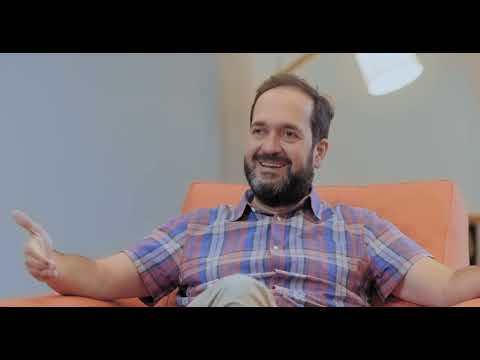 Tabakalera-denbora | Marcos García
08:49
 Tabakalera-denbora | Jone San Martín
10:07
Tabakalera-denbora | Jon Cazenave 07:43
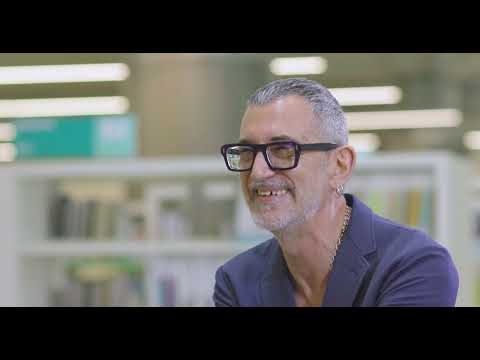 Tabakalera-denbora | Javier Pérez Iglesias
07:49
 Tabakalera-denbora | Isabel Herguera
11:12
 Tabakalera-denbora | Helena Taberna
08:28
 Tabakalera-denbora | Eva Sangiorgi
07:55
Tabakalera-denbora | Dea Kulumbegashvili 09:47
Tabakalera-denbora | Christine Vachon 07:26