00:17 I sometimes say that I’m an activist-librarian, which genders me as female the Spanish language,
00:19 so as to acknowledge the profession
00:22 which is still to this day very feminised.
00:25 There are loads of female librarians
00:28 around the world, not just in Spain.
00:32 I phrase it like that because I think that libraries as an institution
00:38 have such potential, that has only grown overtime,
00:42 and one that is increasingly important
00:45 in the age of staunchly aggressive neo-liberal capitalism
00:50 that looks down upon all things communal and free.
00:54 A library is a call to defend these things, and that still stands today.
01:07 I claim to be an activist because
01:11 I believe libraries require our continuous defence.
01:15 We are an institution
01:18 that is also typically found
01:20 within other institutions.
01:23 The institution sometimes seems to be, and may in fact be,
01:28 an enemy of what is common;
01:30 common in the sense of what people develop
01:33 through their networks and initiatives.
01:36 Yet libraries are a good seed that keeps things from being that way.
01:40 The intention to be open to everyone,
01:43 and for everything inside
01:45 to be for anyone who comes
01:47 to do pretty much whatever they want,
01:49 nurtures that seed and opens up a space
01:53 where unimaginable things happen.
02:00 There is one thing
02:03 about libraries
02:05 that worries me deeply at present,
02:07 and that is being able to ensure
02:11 that people participate,
02:13 that our community
02:15 (when I say “our community”,
02:17 I mean those who come to the library,
02:22 both inside and out)
02:24 can participate.
02:25 I believe that the community must be present in everything,
02:30 even what has always been considered
02:33 strictly the work of a librarian,
02:34 such as the catalogue.
02:36 I think that the people who come to a library,
02:40 those that are interested in what can happen
02:44 and what can be done in a library
02:46 beyond documents
02:47 and the simple use of documents,
02:49 should be able to be involved with the catalogue as well.
02:52 Why not?
02:52 They should be able to be involved
02:54 in how we catalogue,
02:58 how things are categorised and, from there,
03:00 in many other spheres that have been traditionally
03:03 considered to be internal or the work of a librarian,
03:06 and not that of the public.
03:22 I was a child
03:25 in the mid-sixties.
03:26 I was born in ‘61,
03:29 and in my native Santander,
03:31 there weren’t very good libraries.
03:34 With a few exceptions, the Spanish state
03:38 did not have very good libraries in general.
03:40 Libraries and dictatorships
03:42 do not work well together.
03:45 I remember
03:47 the first library I went to,
03:49 which was at my school.
03:51 It was a private,
03:53 elite, religious school,
03:56 with a closed-off library.
03:59 I discovered it
04:01 because a priest once walked past it,
04:03 and for whatever reason he opened it
04:06 and said: “come with me...”
04:08 and there I found a library much larger
04:10 than the one at home, sealed off from the world.
04:12 Not just any library was open,
04:14 now they increasingly are.
04:17 At our library,
04:19 which is also the academic library
04:22 of a higher education institution,
04:24 a university
04:25 that is highly specialised in contemporary thought
04:29 and art, it all revolves around art,
04:31 design,
04:32 restoration, and conservation of cultural assets.
04:36 Even with this framework
04:40 of higher education,
04:41 with this thematic specialisation,
04:45 we are still a library that is open to everyone,
04:47 where anyone can come in and see what we have.
04:51 So, what does a library allow
04:53 into its collections?
04:56 For us, it’s what the community tells us.
05:02 Our community
05:04 is largely composed of artists.
05:07 Naturally, this has led to the introduction
05:11 of artist publications, fanzines, etc.
05:15 and they have even
05:18 organised workshops at the library
05:21 to create such things.
05:23 I think that this is something
05:25 that is happening at Medialab right now as well,
05:28 there is an extremely blurred line
05:31 between what is acquired and what is created,
05:34 because our libraries also have
05:36 an extremely blurred line
05:37 between what is a knowledge,
05:42 reading, and research space, and what is space for creation.
05:51 What draws me most to Medialab, previously Ubik,
05:56 is this way
06:00 that can be created here, where people of all ages
06:04 come together to make such different things with such varied tools.
06:09 And for each tool to be on the same level,
06:11 be it a typewriter,
06:14 a pair of scissors, musical instruments,
06:18 or the books, of course,
06:20 and magazines and DVDs that are there,
06:23 along with the cloud-based collection.
06:26 But above all,
06:27 it is the possibility of finding people here
06:31 that come to find themselves,
06:33 and also end up meeting others and do things with those they meet.
06:38 This is what I love about Medialab,
06:40 and it’s one of the things that we try to emulate
06:45 at our library.
06:51 We have everything properly prepared now.
06:54 Medialab at Tabakalera is a very clear example,
06:58 but all libraries
07:00 try to ensure people can come in and move about freely.
07:05 It’s like with a collection,
07:07 you never have all the elements for a collection that you need
07:12 and you never have all of the room that you need,
07:13 not even here at Medialab
07:16 with its enormous space.
07:18 That means that sometimes
07:21 a space is redesigned or reused for something else,
07:25 but in addition to it being done in a rather organic way,
07:29 more so, it should be done in a way that leaves a space
07:31 for people to make decisions.

 Tabakalera-denbora | Vincent Maraval
09:44
 Tabakalera-denbora | Uxue Alberdi
08:14
Tabakalera-denbora | Ted Hope 08:53
 Tabakalera-denbora | Susanna Tesconi
09:20
 Tabakalera-denbora | Ricardo Díez Muiño
11:15
Tabakalera-denbora | Niño de Elche 08:48
 Tabakalera-denbora | Maria Ptqk
09:47
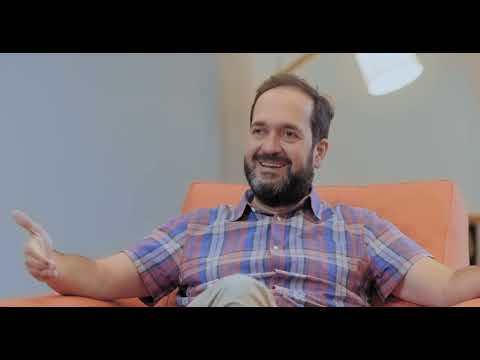 Tabakalera-denbora | Marcos García
08:49
 Tabakalera-denbora | Jone San Martín
10:07
Tabakalera-denbora | Jon Cazenave 07:43
 Tabakalera-denbora | Isabel Herguera
11:12
 Tabakalera-denbora | Helena Taberna
08:28
Tabakalera-denbora | Frédéric Martel 09:04
 Tabakalera-denbora | Eva Sangiorgi
07:55
Tabakalera-denbora | Dea Kulumbegashvili 09:47
Tabakalera-denbora | Christine Vachon 07:26