00:10 I arrived at MediaLab Madrid in 2003.
00:13 I had a very exhibition-related part,
00:17 but also with an interesting approach
00:18 to think of the exhibition hall not only as a place of contemplation,
00:21 but also as a place for conversation, as a place for activities
00:24 and ultimately,
00:28 what it ended up becoming, I think, was as a production site.
00:37 We designed a production workshop
00:39 we end up calling 'interactive?
00:41 with a question mark at the end,
00:42 in which some projects are going to be selected
00:45 or some people who had submitted a proposal and that's it.
00:47 But we said:
00:49 "hey, what about those who have submitted a project
00:51 and are not selected?
00:53 Are they left out?
00:55 And then we said:
00:56 "Well, but why don't we do one thing?
00:58 Why don't we select some projects,
01:03 that are the ones that can be done,
01:06 but then people can sign up to participate as contributors?"
01:10 That was the key to the whole thing,
01:11 because it was what allowed
01:15 to do in a collaborative way the projects
01:18 and anyone could join in,
01:20 with profiles not even foreseen by the person who had proposed the idea.
01:23 From this point on, I think a new stage begins,
01:26 in which all the efforts are focused on how to enable
01:30 a place for production, experimentation, collaboration,
01:33 where anyone can be part of it.
01:42 When, for example, we talk about cultural rights,
01:45 especially the emphasis is put on
01:48 the right of access to certain cultural goods:
01:50 to be able to attend concerts, to go to the theatre,
01:53 cinema, exhibitions, etc.
01:57 and also with a model that is very clear:
02:00 there are some that generate that content,
02:02 there are some broadcasters,
02:03 a channel where it's distributed
02:05 and others involved in reception.
02:07 But in thinking about cultural rights
02:10 there is also another dimension
02:12 which is the right to actively participate
02:14 in cultural life.
02:16 And that's a need that people have,
02:18 we have a need to create things.
02:23 And that, in the model that I would say traditional
02:28 or the model that we've inherited, that's relegated to:
02:31 "you do this privately and individually".
02:39 The difference between institutions, or traditional public policies,
02:45 and what is proposed from the Citizen Labs, I think there are
02:49 a difference in the confidence in what people can do.
02:55 I think, to a large extent,
02:58 the institutions that we have inherited
03:00 are based on the fear of what people can do,
03:04 and the Citizens' Labs proposal is to say:
03:06 "we are confident in what people can achieve
03:09 if the conditions for self-organisation are met,
03:11 so that everyone can develop their own capacities, etc.".
03:16 This is not to say that there will be no conflict,
03:20 there won't be problems and unwanted effects.
03:24 But, as I said before,
03:27 the Citizen Lab would be a device
03:29 that allows when something goes wrong,
03:32 to try to work it out again so that the next time
03:35 it doesn't fail in the same way.
03:39 Because, in a laboratory, what is sometimes a mistake
03:42 then becomes an unexpected finding
03:44 and you never know when it's going to be.
03:49 All that we have to ask ourselves
03:51 how it is reflected in the institutions.
03:54 So, when you talk about, for example, digitalisation processes,
03:57 it can be interpreted as a way of following
04:02 with the same functions as always, and using the digital only for
04:07 to enhance the function of transmission or dissemination of cultural content.
04:14 Or the other way around.
04:16 Can we imagine cultural spaces
04:19 that favour the contributions of anyone?.
04:22 That would be, from my point of view,
04:25 what Citizens Labs is proposing.
04:32 We liked to think of it as a laboratory
04:35 to experiment with forms of mediation,
04:38 understood as a mediation that enables
04:41 spaces of encounter between different people who do not know each other
04:43 to be able to collaborate, to be able to experiment,
04:45 to be able to do new things.
04:47 It's always insisted, in any job, in organisations,
04:51 everybody is looking for people who know how to work in a team.
04:56 and yet how little of it is put into practice.
05:01 in the formative itinerary.
05:07 There's a kind of contradiction there.
05:09 The institutions that we have inherited do not facilitate
05:13 that learning to cooperate that can only happen in practice,
05:18 is not something that can be achieved immediately.
05:21 We will never be able to introduce all the diversity, plurality,
05:26 the complexity of the social within an institution, within a laboratory.
05:31 That's impossible.
05:32 But we can have a horizon,
05:35 and increase the degree of diversity
05:38 of the people who participate.
05:40 I think that's always going to be a challenge for any organisation.
05:44 Who's invited
05:46 to join or contribute?
05:49 And there's always going to be people who feel left out.
05:52 And that's where the role of mediation comes in,
05:56 which would be all these hospitality practices,
06:01 of invitation, of building bridges...
06:03 It's like a never-ending task.
06:06 But in the end it's also the challenge,
06:09 the never-ending task of learning to live together.
06:16 We're more comfortable with that
06:18 that is already consolidated, that which is instituted.
06:20 If we say that we're going to open a library in the neighborhood,
06:24 everybody agrees, everybody knows what it is,
06:26 but if we say that there's going to be a Citizen's Laboratory
06:29 you have to tell what it is, because it's really
06:31 it's a somewhat minority practice at the moment.
06:34 What is new, what opens up possibilities,
06:37 is also built in shaded areas.
06:40 Not many people are involved at the beginning, etc.
06:46 That's where I would go to the timing issue.
06:49 How long does a new model institution take?
06:57 Because I think there's something new about it,
07:00 in becoming something more recognisable and established.
07:03 And I wouldn't know the answer,
07:05 but it's certainly not overnight.
07:07 Imagine the centuries of evolution
07:10 of the library, for example, or the museum.
07:14 We're talking about very long processes.
07:18 At the same time, I would say that the Citizens' Laboratories
07:21 are not just new-fangled institutions
07:24 that need special space,
07:27 but they are also tools to open
07:32 spaces for experimentation in existing places and institutions:
07:38 the school, the university, the library...
07:42 That's why the case of Tabakalera's MediaLab is so interesting.
07:47 because, all of a sudden, the laboratory and the library merge into one.
07:59 A Citizen's Laboratory
08:01 has to be an inviting place to be,
08:03 inviting to do together,
08:05 to invite others,
08:07 to always be open to someone new to join.
08:09 My impression of MediaLab Tabakalera in the time I've been there
08:13 is that it's a very open place, a very pleasant place to be,
08:19 a place that is flexible and modifiable,
08:23 so it's like users seem to be able to move around
08:27 and adapt places easily.
08:30 I see it as a place where you want to be.

 Tabakalera-denbora | Vincent Maraval
09:44
 Tabakalera-denbora | Uxue Alberdi
08:14
Tabakalera-denbora | Ted Hope 08:53
 Tabakalera-denbora | Susanna Tesconi
09:20
 Tabakalera-denbora | Ricardo Díez Muiño
11:15
Tabakalera-denbora | Niño de Elche 08:48
 Tabakalera-denbora | Maria Ptqk
09:47
 Tabakalera-denbora | Jone San Martín
10:07
Tabakalera-denbora | Jon Cazenave 07:43
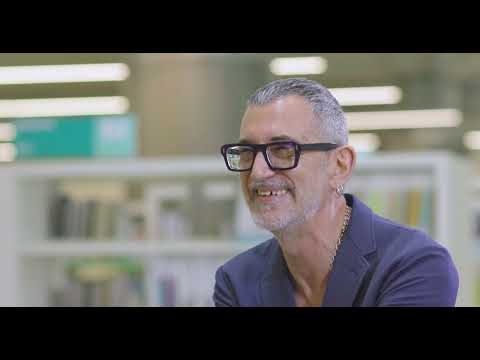 Tabakalera-denbora | Javier Pérez Iglesias
07:49
 Tabakalera-denbora | Isabel Herguera
11:12
 Tabakalera-denbora | Helena Taberna
08:28
Tabakalera-denbora | Frédéric Martel 09:04
 Tabakalera-denbora | Eva Sangiorgi
07:55
Tabakalera-denbora | Dea Kulumbegashvili 09:47
Tabakalera-denbora | Christine Vachon 07:26