00:12 Throughout my life, I have combined architecture,
00:17 design and art, I have worked with all three disciplines.
00:23 I thought you could move from one to the other.
00:30 With the time,
00:32 I understood that the three disciplines are totally different.
00:34 and should not be mixed.
00:43 Art is one thing, design is another,
00:47 and, in many ways,
00:51 are totally opposite disciplines;
00:53 art, by definition,
00:56 cannot be useful,
00:59 and, on the contrary,
01:01 the design has to be, yes or yes.
01:04 Art works in a free way
01:09 and the design always starts from a commission or a problem.
01:16 The design has to be very common,
01:18 it doesn't have to stand out,
01:20 because its value lies, precisely,
01:22 in its discretion.
01:28 The exhibition 'Orain diseinua!
01:30 was a starting point
01:33 to showcase Basque industrial design
01:40 and organise its history.
01:43 You also have to take into account
01:45 that industry is a distinctive feature
01:49 of Basque society,
01:53 one of its active elements,
01:58 and if we don't take care of it as a society,
02:03 we will always have to resort to emulating the ways of others.
02:10 and, moreover, our forms will be lost,
02:14 our characteristic shapes,
02:17 the forms that define us as a society.
02:32 Where is design today,
02:35 where can we see it?
02:37 In a lot of products.
02:39 All products are designed,
02:42 better or worse.
02:44 When I talk about design,
02:46 I think about design excellence,
02:49 and that excellence can be found in a lamp company,
02:53 in telephones, of course...
02:56 For me, there are no limits in that respect.
03:00 For me, the limit is excellence,
03:04 and excellence can be found in an eyewear company as much as it can be found in an eyewear company.
03:09 as in an espadrille company.
03:19 I don't like too much the contemporaneity of art and time.
03:25 Often, contemporary art
03:28 is based on the previous forms.
03:32 I don't consider that contemporary art
03:37 is synonymous with quality,
03:41 so I don't care what date the works were carried out.
03:50 what I'm interested in is the reaction they generate in me.
04:05 I would say that both the historians and the critics
04:09 take on a role that is not theirs;
04:14 i.e. art happens.
04:17 They consecrate, question or locate art.
04:22 in sacred places,
04:25 museums and cultural centres,
04:29 and put up obstacles
04:30 so that their figure of mediator is necessary.
04:34 Anyway,
04:39 I don't think it's unacceptable.
04:46 The art...
04:47 people relate spontaneously to art.
04:52 The problem is that the lack of knowledge
04:54 causes us not to notice it.
04:56 We can go back to the design example:
04:59 somebody can say they don't like the design,
05:03 but he probably has several design elements in his kitchen.
05:08 The point is, he doesn't know.
05:10 To fight against ignorance,
05:14 three actions can be taken:
05:16 educate, educate and educate.
05:30 If we improve education,
05:32 culture will find its way.
05:34 We cannot invest in culture
05:36 if the public is not well educated.
05:40 I have to teach myself to read
05:45 to my fourth-year university students.
05:52 They can read,
05:55 but at the moment they are asked for an opinion,
05:57 an analysis, an input,
06:03 they are not able to do it.
06:06 Therefore,
06:08 if you put those people in a contemporary art museum,
06:12 they run away, they run away in terror.
06:16 Because art puts you in front of a mirror.
06:26 Administrations that want to promote culture
06:33 present ambitious projects with large infrastructures.
06:40 But at the end of the day, it's a real estate business,
06:48 not for the benefit of culture.
06:55 It is true that infrastructures are necessary,
06:58 but what we really, really, really need
07:01 is to take care of culture, day by day, little by little...
07:08 And, in my opinion,
07:10 we're still going to need a few more years
07:12 for our society to understand this position.
07:24 I'd like Tabakalera to be like a reservoir.
07:31 Let's look at other cities of a similar size to Donostia:
07:37 e.g. Zurich, Düsseldorf and Lausanne.
07:43 Why are they more attractive
07:47 and, dare I say, more beautiful than Donostia?
07:52 I think it's because the culture has overflowed.
07:55 and it's hit the streets,
07:59 and that doesn't happen in Donostia.
08:04 So I would like that all Tabakalera shares
08:09 resemble a reservoir and that, I don't know,
08:12 five years from now, the water would overflow
08:17 and culture will flood the whole of Donostia.

 Tabakalera-denbora | Vincent Maraval
09:44
 Tabakalera-denbora | Uxue Alberdi
08:14
Tabakalera-denbora | Ted Hope 08:53
 Tabakalera-denbora | Susanna Tesconi
09:20
 Tabakalera-denbora | Ricardo Díez Muiño
11:15
Tabakalera-denbora | Niño de Elche 08:48
 Tabakalera-denbora | Maria Ptqk
09:47
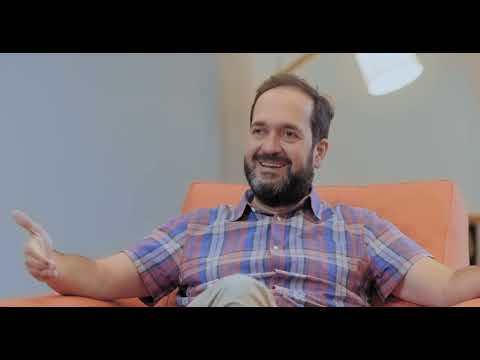 Tabakalera-denbora | Marcos García
08:49
 Tabakalera-denbora | Jone San Martín
10:07
Tabakalera-denbora | Jon Cazenave 07:43
 Tabakalera-denbora | Javier Pérez Iglesias
07:49
 Tabakalera-denbora | Isabel Herguera
11:12
 Tabakalera-denbora | Helena Taberna
08:28
Tabakalera-denbora | Frédéric Martel 09:04
 Tabakalera-denbora | Eva Sangiorgi
07:55
Tabakalera-denbora | Dea Kulumbegashvili 09:47